

Materials
PLA or PETG: why we print everything in PLA
Two materials that look the same and behave differently. Why we choose PLA, and where you are better off not using it.
MODUXO
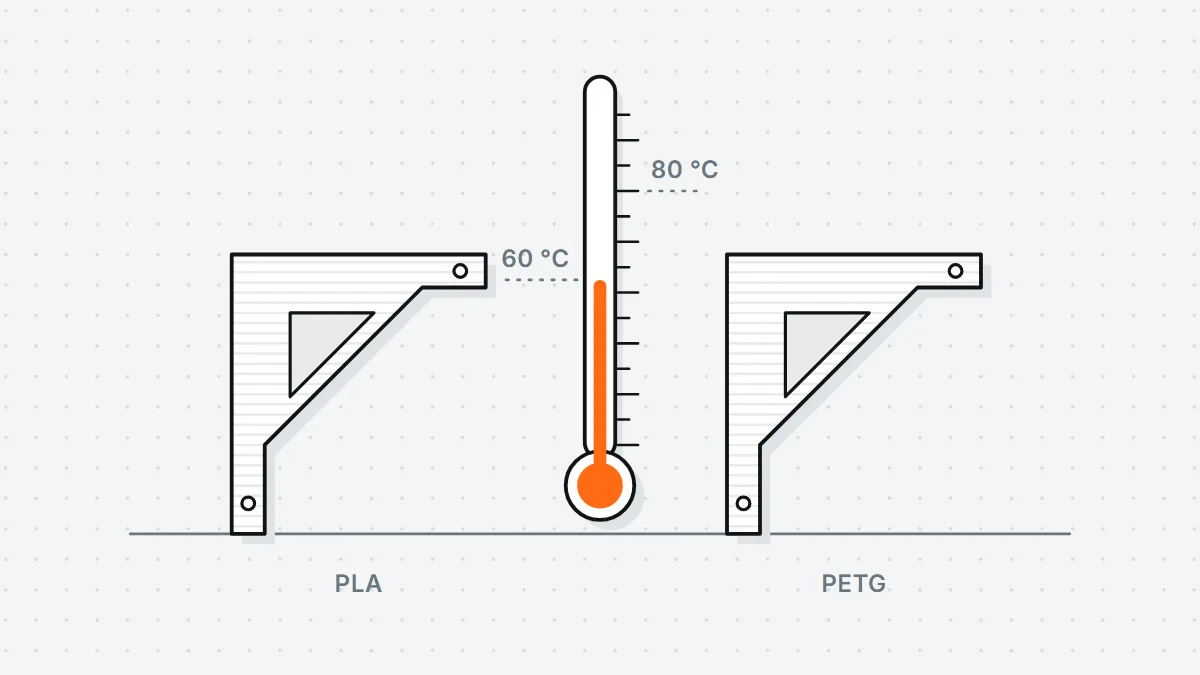
Put two parts side by side, one in PLA and the other in PETG, and you won't see the difference. In use, you will. We print everything in PLA. Here is why, and where you're better off not using it.
The difference in one paragraph
PLA is stiff and dimensionally accurate, and it snaps if you bend it too far. PETG is tougher: it bends first and springs back, and it copes with more heat. On the other hand, PETG gives slightly less crisp detail and scratches more easily.
| PLA | PETG | |
|---|---|---|
| Softens at around | approx. 55–60 °C | approx. 75–80 °C |
| When bent too far | snaps | bends and springs back |
| Accuracy and detail | very good | good |
| Outdoors and UV | discolours and turns brittle | lasts longer |
| Scratch resistance | harder surface | scratches more easily |
Why we choose PLA
Almost everything we make is used indoors: on a wall, under a desk, in the meter cupboard or next to a network cabinet. That is where PLA wins on the points you can see and feel. It holds its dimensions, so a holder fits snugly around the device it was made for, and the surface is hard and clean. Because we work with one material, we know exactly how it behaves and design every part around it. So with us, you never have to think about the material.
Where PLA doesn't belong
The classic case: a holder in a car. A car parked in the sun easily reaches 60 to 70 degrees inside, and that is where PLA goes soft. The holder will quite literally sag.
- Indoors, with no heat source close by: this is what PLA is made for.
- Near equipment that gets warm, such as a battery charger or a power adapter: keep the ventilation openings clear and don't mount the holder above a radiator.
- In a car, outdoors, or behind glass in full sun: not suitable.
- Load-bearing, more than a few kilos: a printed part is not the right choice, and you are better off with a metal bracket.
What the product page tells you
Every product lists the material in its specifications and, where it matters, what to watch out for when it comes to heat. Not sure whether a product suits your situation? Just ask — for us it's a short email, and for you it's the difference between a part that lasts for years and one that sags within two months.