Mounting
Your battery charger on the wall: a clear workbench again
A battery charger takes up the most useful bit of your workbench. Put it on the wall and you get that space back, and the charger is no longer sitting in the sawdust.
MODUXO
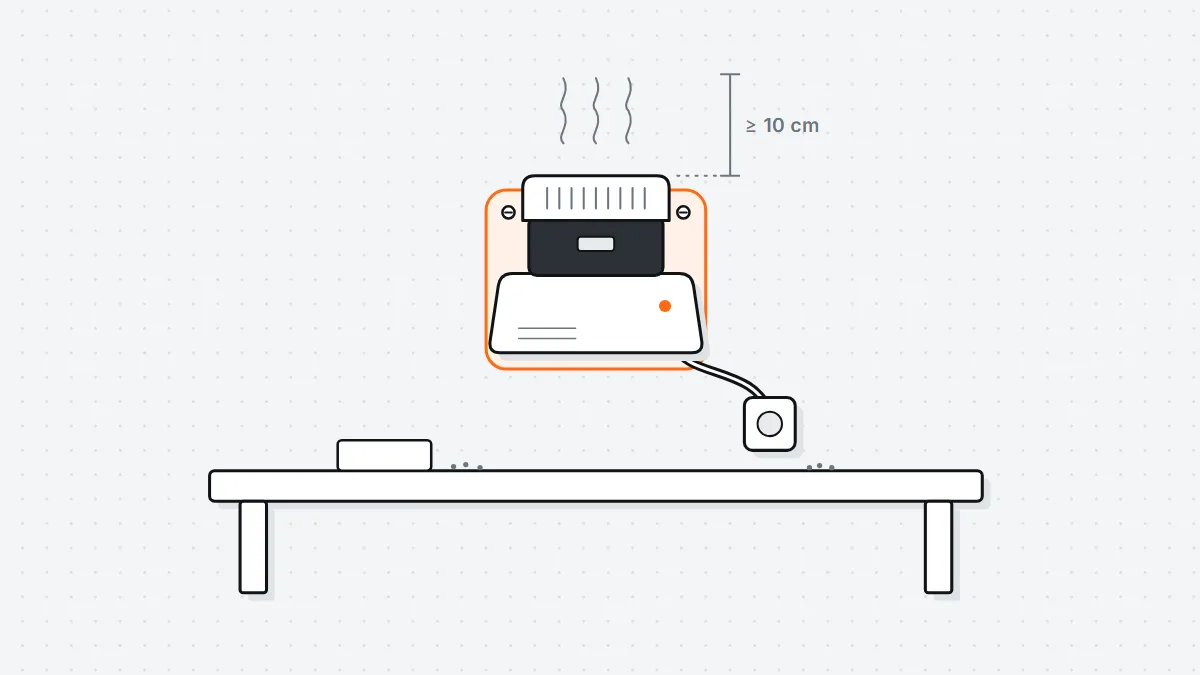
A battery charger sits in the middle of the workbench, because that's where the socket is. That's usually exactly where you want to work, too. Hang it up and you get that bit of bench back, and the charger is no longer sitting in the sawdust.
Set the height by the battery, not the charger
You don't reach for the charger, you reach for the battery. So hang the charger so the battery sits at chest height: then you can take it out with one hand without stretching. Too high and you're lifting a full battery down from overhead; too low and you're bending down every time.
Heat and airflow
A fast charger gets warm, and a charger that can't get rid of its heat will throttle back to a lower charging rate. Charging then takes longer and the battery gets warmer than it needs to, which costs it capacity over time.
- Keep the ventilation openings clear. Don't hang it wedged between two cabinets.
- Leave at least ten centimetres clear above the charger, because warm air rises.
- Not above a radiator, and not right next to a heater in the workshop.
Dust is the real problem
In a workshop with a saw or a sander, a charger gets dusty inside, and that dust ends up exactly where the fan draws air through. So don't hang the charger directly above your saw station or in the airflow of your dust extraction.
Blow it out now and then with low-pressure compressed air, with the plug pulled out. Once a year is enough, and it saves you from a charger that suddenly charges slowly.
Power
Let the power cable form a loop before it runs to the socket; that way you don't pull on the connection when you grab the battery. If there's no socket nearby, use a power strip fixed to the wall rather than an extension lead across the floor — in a workshop, that's a trip hazard waiting to happen.
Drilling into a workshop wall
It's often concrete or calcium silicate brick: 6 mm drill bit, nylon wall plug, 4 x 40 mm screw, hammer action on. If the charger is going on a timber stud wall, screw into the stud itself and not just into the boarding. A charger with a battery in it easily weighs a couple of kilos, and it'll be hanging there for years.