

Mounting
Which wall plug for what: plasterboard, brick, concrete or wood
Most holders don't come off the wall because they're too weak, but because the wrong plug went in. Wall by wall, what goes in.
MODUXO
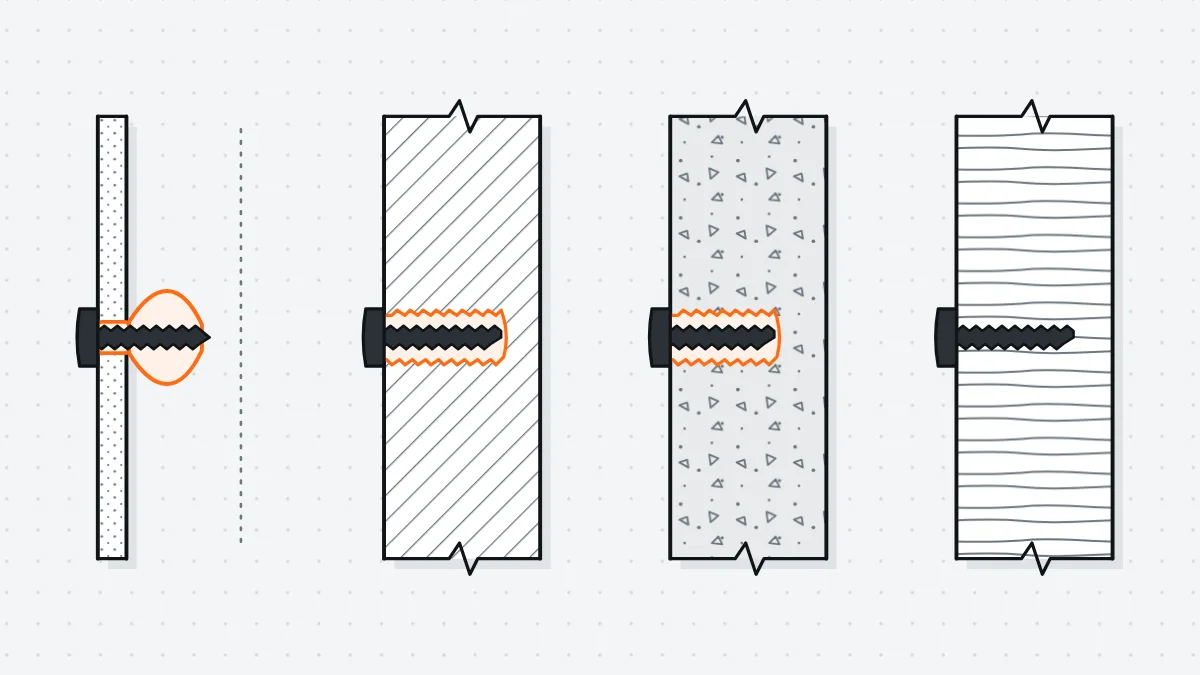
A holder that comes off the wall is almost never a holder that was too weak. Nine times out of ten, the plug in it didn't suit the wall. Here's how to tell what you're dealing with.
First: what's behind it?
Carefully drill a hole of a few millimetres and look at the dust that comes out.
- White and powdery, drills very easily — plasterboard or aerated concrete.
- Red or yellow, gritty — brick.
- Grey, and the bit keeps catching — concrete.
- Light grey and fine, drills fairly easily — calcium silicate brick.
- Shavings instead of dust — wood.
Plasterboard
The most common mistake: an ordinary nylon plug in plasterboard. It spins at first and then slowly works itself loose. Use a cavity wall plug or a metal toggle, or find the metal stud behind the board and screw into that. A magnet finds those studs in a few seconds.
For anything that carries real weight, screwing into the stud always beats any plug.
Brick and calcium silicate brick
An ordinary nylon plug works fine here. Drill 6 mm with hammer action on, and blow or vacuum the hole clean before you push the plug in — drilling dust left in the hole halves the holding power. Drill into the brick itself, not the mortar joint: mortar is softer and crumbles.
Concrete
A nylon plug again, but you need a decent hammer drill and some patience. If you hit a reinforcing bar, the bit suddenly stops without going any deeper. Move the hole a few centimetres. Drilling through rebar is not a good idea.
Aerated concrete
This is the deceptive one: it drills like butter, so it feels easy. But an ordinary plug barely grips. Use a dedicated aerated concrete plug, or a long screw without a plug that cuts its own way into the material. Don't use hammer action here; it only makes the hole bigger.
Wood
Drill a pilot hole of about two thirds of the screw diameter and screw straight in. You don't need a plug, and it only weakens the fixing.
Two things that always apply
- Check for cables. Within thirty centimetres of a socket or switch there are almost always cables, usually running straight up or straight sideways. Use a cable detector.
- Then give it a tug. Hang your full weight on the bracket for a moment before you put the device in. Better now than six months from now.